At Brand Felt Group, we are vertically integrated manufacturers. This means we manufacture the raw material ourselves and convert it in-house, under one roof. It gives us tighter quality control, faster turnaround, and a single point of contact for you.
So, what does “convert” actually mean? Converting is a manufacturing process where complete rolls or sheets of raw material are turned into finished products. That can mean cutting it to an exact shape, slitting it to width, adding adhesive backing, laminating it to another material, or stitching it into a final product. It's the difference between buying a sheet of material and buying the actual part that goes into your product.
Difference between cutting and converting
While used interchangeably, cutting and converting are actually separate processes. Converting is an umbrella term for processes that transform materials into finished or semi-finished products. Cutting is one specific action under converting, where a machine cuts the raw material into smaller pieces or specific shapes.
Cutting can be done by blades, water jets, lasers, and other cutting technologies. They shape or section the material into smaller pieces, gaskets, rings, etc.
Converting includes cutting along with other value-added processes such as adhesive application, lamination, folding, assembly, dyeing, and sewing.
Let’s walk through all the different ways you can cut and convert material with us.
Die Cutting
Die cutting uses specialized tools to cut and shape material like felt, foam, and cork. It’s an essential tool if you want to produce exact shapes at scale. This process uses a die to ensure shapes are consistent each time. A die is like a cookie cutter but built for industrial volume. It’s available as a steel-rule die or rotary die.
We carry over 5,000 dies in stock, which lets us move fast on high-volume orders without waiting on tooling. We run a range of die cutting methods depending on the job — rotary press, beam press, ATOM CNC die cutting, and clicker presses. If you have a custom shape in mind that isn't in our existing die library, we can build custom tooling to match it.
Kiss Cutting
You might have heard of kiss cut and die cut used interchangeably. They are similar but they have one significant difference. Kiss cutting is used for materials that have an adhesive back. It uses a die to cut through only the top part of the material, leaving the liner, or backing, untouched.
When die cutting, you cut through the entire material. When kiss cutting, you cut through the material but leave the liner as is.
This is perfect for applications where quick and clean placement is essential.
We also offer sheeting kiss cutting, with the ability to kiss cut and sheet at the same time. This means the roll of material is kiss cut into a desired shape while leaving the liner intact. It is simultaneously being cut into finished sheets, ready for packaging or the next manufacturing step. Our machines ensure precision and repeatability.

Skiving
In manufacturing, skiving is a specialized machining process where a sharp blade trims, peels, or cuts thin layers off the top of a raw material. It enhances the customer’s product durability and design.
The most important application for skiving at Brand Felt Group, is ensuring very tight tolerances in our material. It helps make the top of the surface even.
Our skiving machine can cut 750mm wide and up to 1 inch thick. However, the 1 inch is split into skiving 12.5mm at the bottom and 12.5mm at the top.

Roll Slitting
What is the difference between cutting and slitting? They sound almost similar but they’re not! Slitting specifically cuts master rolls down to narrower strips or rolls. The strips can be of a custom width and give us material that is ready to use, without further trimming.
Our process ensures smooth, clean cuts with minimal fraying. We can slit most master rolls with or without adhesive, into strips starting at 3/16” width.

Adhesive Coating
As the name suggests, adhesive coating is layering a bonding agent such as glue, to a material. It can either be a traditional adhesive, pressure sensitive adhesive, or heat sensitive adhesive. Usually, a second backing material is applied on top of the adhesive, such as a liner, to keep the glue intact until it’s ready to be used.
What is the difference between traditional adhesive, PSA, and HSA?
A traditional adhesive is one where a substance gives tack with a chemical reaction – like glue. You apply the glue, wait for it to tack, and then join the surfaces.
In pressure-sensitive adhesives, the two surfaces are bound when pressure is applied. Pressure sensitive adhesive coating adds a strong, reliable bond to any material for easy installation. We offer a range of adhesive options depending on your application, including 3M adhesive. Our PSA backing can be applied to most of our products.
Heat-sensitive adhesives are dry at room temperature, melt with heat, and become tacky. Since they’re dry at the start, it allows manufacturers and converters to place them properly before heating them. Once cool, they polymers lock in place.

Laser Etching and Cutting
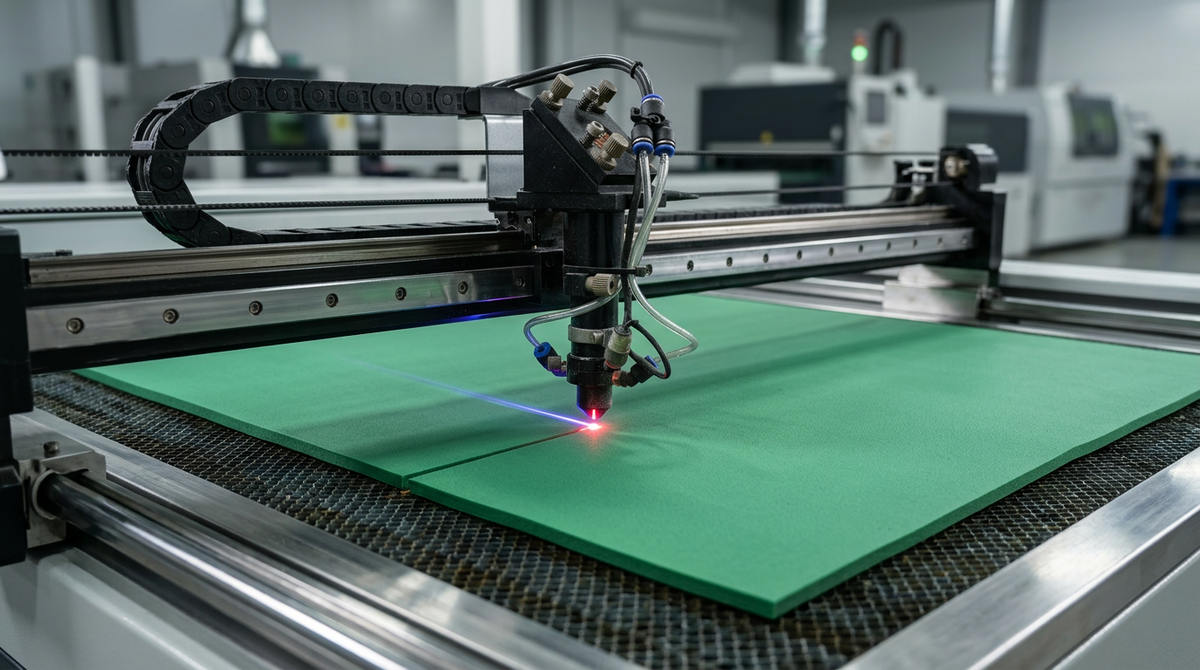
At Brand Felt Group, we can do both laser etching as well as laser cutting.
With laser etching or engraving, the laser doesn’t cut all the way through the material. It burns or marks the surface lightly to leave a permanent design. This helps with branding materials with logos or marks.
Laser cutting is where the laser cuts all the way through the material, separating it into smaller pieces or specific shapes. It is similar to CNC cutting or die cutting, except it uses a laser. This is preferred for intricate details and shapes where a laser can cut more precisely than a blade.
Depending on the material density and surface, we can offer this service for materials like vinyl, foams, felts, and cork.
It's important to note that the finished edge can vary depending on the material being cut. Natural fiber felts, such as wool and viscose, will typically develop a slightly darkened or scorched edge as a result of the laser cutting process. Some synthetic felts may also exhibit minor edge melting or discoloration, although this is often minimal because the laser cuts through many synthetic materials very quickly.
The extent of any edge effects depends on factors such as the material composition, thickness, density, and the specific cutting parameters used.
If edge appearance is critical for your application, we recommend consulting our team to get the results you're looking for.
Waterjet Cutting
Waterjet cutting is used when the material is too hard to cut with a blade or laser. Highly pressurized water is released through a hole in a gemstone (usually diamond, ruby, or sapphire).
For hard materials such as stone or glass, waterjet cutting uses sand. When the water is released, it creates a vacuum that draws garnet sand into the stream and fires it at the material. The sand then “cuts” away at a high speed.
However, for materials such as high density felt, dense foams, and cork, only high-pressure water is used. This means sand doesn’t have to be cleaned off the material and it doesn’t damage it in any way. Moreover, our materials can be cut with just water and don’t need sand.
CNC-Cutting
Computer Numerical Control (CNC) cutting is when a computer controls a 3-axis Cartesian arm with a blade to make cuts in a material. It is ideal for low-to-mid volume runs, prototypes, or oversized parts where a die wouldn’t make sense.
CNC cutting is ideal for irregular shapes, thicker material, and complex, one-of-a-kind shapes with precision and accuracy.
Our CNC bed measures 2000mm x 4000mm (87" x 157"), and our CNC knife can cut material up to 76.2mm (3 inches) thick. Our in-house CAD/CAM team — including 3D capabilities and a digitizer — can take a hand sketch or rough concept and turn it into a usable 2D or 3D drawing. We also offer CNC routing for parts that need more than a straight cut.
Difference between CNC, Laser, and Waterjet cutting

Lamination
Lamination is permanently bonding two or more materials together into a single composite. This lets us combine the properties of two materials into one part - cushioning plus durability, insulation plus a finished surface, and so on.
With your choice of PSA (pressure-sensitive adhesive) or HSA (heat-sensitive adhesive), we offer our customers laminating services for rolls, sheets, and die cut pieces. We offer this service for our wide range of materials such as foam with felt, foam with aluminum, felt with cork, felt on felt, and foam with cork.
Acid-based chrome dyeing
Acid-based dyeing is a specialized color process we use primarily for wool products. The process starts by heating water to between 30-40° C, then introducing the dye and bringing it up to a boil.
Because wool is naturally alkaline, it needs to be neutralized with a small amount of acid before it can accept the color evenly. Once neutralized, the material is dyed and then fixed with acid, which locks the color permanently.
This is a chrome dye process, so it's exclusive to wool — the fiber chemistry is what makes the reaction work. We offer custom colors, so if you have a specific shade in mind, we can match it rather than limiting you to a standard palette.

Sewing
Sewing is done as the last step in the assembly line for soft materials. It turns cut pieces into finished, assembled products with bound edges, reinforced seams, or fully constructed items.
Our sewing department is equipped with over 40 machines capable of sewing felt, leather, neoprene, and more. We are trusted with finishes such as seams and edging or making products such as bags.

Every capability above can stand alone or work together - a part might be CNC-cut, laminated, adhesive-backed, and sewn. That's the advantage of working with a vertically integrated converter: fewer vendors, fewer handoffs, faster timelines.
Need to test an idea first? We offer prototyping, so you can validate a design before committing to a full production run.
Have a custom shape, size, or blend in mind? Our custom capabilities mean we're not limited to standard materials. If you have a unique challenge, we can help you solve it.
Ready to talk specifics? Contact us and let's figure out how to bring your project to life.